


In this article
The oil and gas industry has come a long way since the 90s. But how far? Some manufacturers of industrial valves, pumps, drilling equipment, pipelines, pressure vessels, and other critical components use smart manufacturing technologies to improve productivity, operational efficiency, and product quality; others don’t yet. They often find it difficult to handle equipment data, inventory, production scheduling, and financial operations separately due to a lack of real-time visibility and limited process automation.
This blog is for them. They can integrate their disconnected workflows with an integrated ERP solution: Oil & Gas ERP Dubai. How Odoo ERP Supports Smart Manufacturing: Odoo ERP connects manufacturing operations, machine data, automation systems, and business processes. This makes it easier for manufacturers to shift to a more connected, intelligent, and efficient production environment.
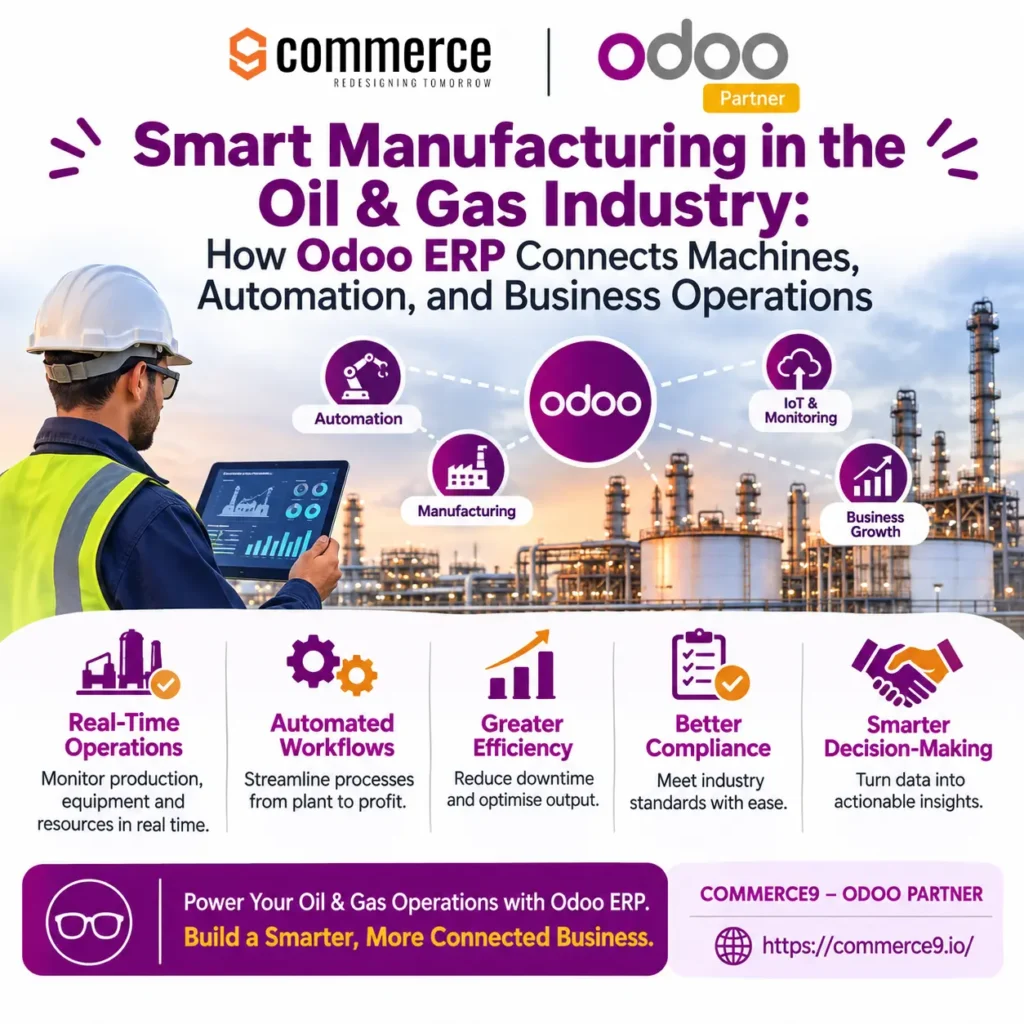
How Odoo ERP Connects Machines, Automation, and Business Operations
Odoo partner in Dubai does it through a centralised system. Machine data integration includes connecting IoT platforms, industrial systems, and middleware. This provides machine data, which can be shared with connected business applications for better operational visibility and monitoring. Odoo simplifies production planning by managing manufacturing orders, work centres, production schedules, and material requirements. This makes production planning and resource allocation easier and more effective. Workflows such as inventory replenishment, maintenance requests, and activity notifications are automated to reduce repetitive manual tasks and respond to operational requirements faster. Odoo’s centralised platform together shows production, inventory, purchasing, and accounting records. This makes it easy for teams to access shared operational information, improve coordination, and make decisions using consistent, updated data.
Key Applications of Odoo ERP in Smart Manufacturing
Automated Production Planning
Smart manufacturing in oil and gas industry manages and coordinates production workflow. They also improve production visibility, reduces manual data entry, and supports more efficient manufacturing operations. This simplifies planning production activities, managing resources, and monitoring progress. Five features offer these advantages: bill of materials (BoM), manufacturing orders, work centers, production planning, and shop floor management.
The bill of materials defines the raw materials, components, and quantities required to manufacture each product.
Manufacturing orders create and manage production orders based on customer demand, forecasts, and material availability.
Work centers arrange production workstations, capacities, working schedules, and operations. This coordinates manufacturing activities efficiently.
Production planning is done based on demand, material availability, and resource capacity. You monitor production progress, coordinate manufacturing orders, and work-centre schedules.
Shop floor management provides operators with an organised interface to access work orders, record production activities, and update operational progress.
Predictive Maintenance and Equipment Monitoring
Unexpected equipment breakdown can disrupt manufacturing schedules, increase maintenance costs, and reduce productivity. Odoo maintenance, connected sensors, and IoT integrations help monitor equipment performance and manage maintenance activities more effectively. Together, they monitor equipment performance, record equipment faults, schedule preventive maintenance, manage repair activities, track spare parts availability, analyze recurring issues, and enable predictive maintenance.
Monitoring equipment performance includes connecting sensors to collect machine data, such as operating hours, temperature, vibration, and equipment condition. This identifies unusual performance patterns.
Odoo records equipment faults such as document breakdowns and maintenance requests, and maintains detailed equipment service histories.
Preventive maintenance is scheduled based on operating hours, usage, or planned service intervals. This reduces unexpected failures.
Managing repair activities includes assigning maintenance tasks to technicians, tracking repair progress, and coordinating maintenance activities.
Tracking spare parts availability includes monitoring spare parts inventory to ensure essential components are available when repairs are required.
Analysing recurring issues includes reviewing maintenance records and equipment history to identify recurring faults and improve maintenance planning.
Integrating sensor data with suitable IoT analytics tools enables predictive maintenance. This detects unusual operating patterns and anticipates potential equipment failures.
A model information to know is that the basic Odoo ERP functionally supports maintenance scheduling and tracking, while advanced predictive maintenance requires additional sensor infrastructure, data analytics, and suitable integrations.
Inventory and Spare Parts Management
This includes tracking essential inventory, setting replenishment rules, and coordinating purchasing and stocking availability.
Tracking essential inventory includes monitoring raw materials, components, consumables, and critical spare parts. It maintains accurate stock records and availability.
Setting replenishment rules establishes minimum stock levels and automated replenishment rules to ensure essential materials and spare parts are available when needed.
Coordinate purchasing and stock availability by connecting inventory management with purchasing processes. This ensures timely procurement and reduces operational delays caused by material shortages.
Quality Control and Operational Reporting
In this phase, a certified Odoo partner records quality checks, maintains inspection records, monitors manufacturing performance, and identifies recurring issues.
Recording quality checks ensures products meet defined standards.
Maintaining inspection records includes storing inspection results, production details, and product traceability. This maintains accurate quality records.
Monitoring manufacturing performance includes using operational reports to track production activities, evaluate performance, and identify areas for improvement.
Analyse quality reports to identify recurring issues, monitor quality trends, and take corrective action to enhance production consistency.
Benefits of Integrating Odoo ERP with Industrial Automation
An Odoo ERP integration with industrial automation offers better operational visibility, reduced manual work, improved equipment availability, more informed decisions, and better coordination.
Better operational visibility gives access to real-time production, inventory, and maintenance information through connected workflows to monitor operations and identify potential issues.
Manual work is reduced due to automated data exchange between machines, production systems, and ERP modules. Automation reduces repeated data entry, minimises errors, and saves employees time.
Connecting maintenance schedules, equipment performance data, and spare-parts planning improves equipment availability, enables planned preventive maintenance, and reduces unexpected equipment downtime.
With production data, operational metrics, and cost reports, you can evaluate performance and identify inefficiencies for faster and more informed decisions.
Connect production, procurement, maintenance, inventory, and finance teams through consistent business information for better coordination, improved communication, and simple workflows.
Challenges to Consider During Implementation
- System Compatibility – Ensure the new solution is compatible with existing machines, sensors, PLCs, SCADA systems, and ERP platforms. Proper integration helps maintain seamless communication between operational and business systems.
- Data Accuracy and Consistency – Verify that data from different systems is accurate, consistent, and properly structured. Reliable data is essential for effective monitoring, reporting, and decision-making.
- Cybersecurity and Access Control – Connected industrial environments require strong security measures to protect operational data and critical infrastructure. Implement role-based access controls, secure connections, and regular security monitoring.
- Employee Training and Workflow Changes – Prepare employees to work with new systems through practical training and clear guidance. Review existing workflows to ensure the technology supports daily operations without unnecessary disruption.
- Integration Costs and Implementation Timelines – Assess software costs, hardware requirements, integration expenses, and expected implementation timelines. A clear budget and project plan help minimise unexpected costs and delays.
- Future Scalability – Choose a solution that can accommodate increasing operational demands, additional facilities, connected equipment, and evolving business requirements. This helps businesses expand without repeatedly replacing their technology infrastructure.
Conclusion
Smart manufacturing in oil and gas industry connects industrial automation with business operations to create more efficient, responsive, and data-driven production environments. Oil & gas ERP Dubai coordinates production planning, inventory, maintenance, procurement, and reporting through a unified platform. With the right integrations, businesses can convert machine-level data into actionable insights, improve operational visibility, and make informed decisions.
Commerce9, an Odoo partner in Dubai, specialises in ERP implementations, digital transformation, and intelligent business solutions to help organisations move beyond traditional ERP deployments toward scalable, AI-enabled systems that drive measurable business outcomes.
Frequently Asked Questions
What is smart manufacturing in the oil and gas industry?
Smart Manufacturing in the Oil & Gas Industry combines industrial automation, connected machinery, and digital technologies to improve production efficiency, equipment monitoring, and operational decision-making.
How does Odoo ERP connect automation and business operations in the oil and gas industry?
Odoo ERP connects production, inventory, procurement, maintenance, and finance to streamline Automation and Business Operations. With suitable integrations, it can also use machine-generated data to improve operational visibility.
Why should oil and gas companies work with a Certified Odoo partner?
A certified Odoo partner understands ERP implementation, customisation, and integration requirements. Working with an experienced Odoo partner in Dubai like Commerce9 helps businesses develop solutions aligned with their operational needs.
Is Odoo ERP suitable for oil and gas businesses in Dubai?
Yes. Odoo can be customised to support equipment maintenance, inventory, procurement, project management, and financial operations. Commerce9 provides oil & gas ERP Dubai solutions tailored to business workflows and industry requirements.

Vinoj VK
Vinoj brings over 15 years of industry experience, offering deep knowledge and practical expertise. He is dedicated to delivering reliable insights and high-quality content across a wide range of topics.