


In this article
In the UAE, Generation X business owners issue invoices to their customers. Decades later, the UAE Ministry of Finance established the mandatory e-invoicing initiative to issue invoices and credit notes in XML format using the PINT-AE standard.
The goal is to shift businesses from printing to an electronic system to improve tax compliance, transparency, and financial reporting. If your revenue is AED 50 million or more, your mandatory go-live deadline is this new year. If it’s less than AED 50 million, your deadline is 1 July 2027. So, if you’re an SME, this is your first call to review your existing accounting software, invoicing procedures, customer records, and financial workflows for a smooth transition.
What is an Odoo ERP’s role here? It brings your invoicing, accounting, customer records, and financial workflows into a single integrated platform. Its configuration and integrations support e-invoicing readiness.
So, SMEs, this blog is for you. In this blog, you’ll read about the UAE e-invoicing requirements, steps you need to take to prepare, how Odoo ERP supports the transition, and how to plan for a smoother implementation.
Understanding Mandatory E-Invoicing in the UAE
UAE mandatory e-invoicing includes the development, exchange, and processing of invoices in a digital format. An e-invoice includes information that can be read by machines used in accounting and taxation. Why is it compulsory? To upgrade the financial process, strengthen tax reporting, improve transaction visibility, maintain accurate financial recordkeeping, and make processing of invoices easier. Benefits of the e-invoicing include improved accounting and taxation, reduced number of mistakes caused by human factors, fast processing, and easy keeping of the financial records. It is being implemented step by step. Requirements and timing of implementation depend on the types of businesses and its volume of activity. It is necessary to check the latest updates and announcements of the Federal Tax Authority (FTA) to be informed about the timelines and conditions set for the implementation of e-invoicing regulations.
Why UAE SMEs Should Prepare for E-Invoicing Early
For five reasons: manual invoice creation and data entry, difficulty managing large invoice volumes, errors in VAT calculations and customer information, delays in payment processing, and difficulty maintaining financial records.
Preparing early has five advantages: gives you time to review existing invoicing processes and identify gaps, allows SMEs to select and configure appropriate e-invoicing or ERP solutions, provides time to integrate invoicing systems with accounting and other business applications, helps employees become familiar with new workflows through proper training, and reduces risks such as last-minute system changes, operational disruptions, and compliance-related issues.
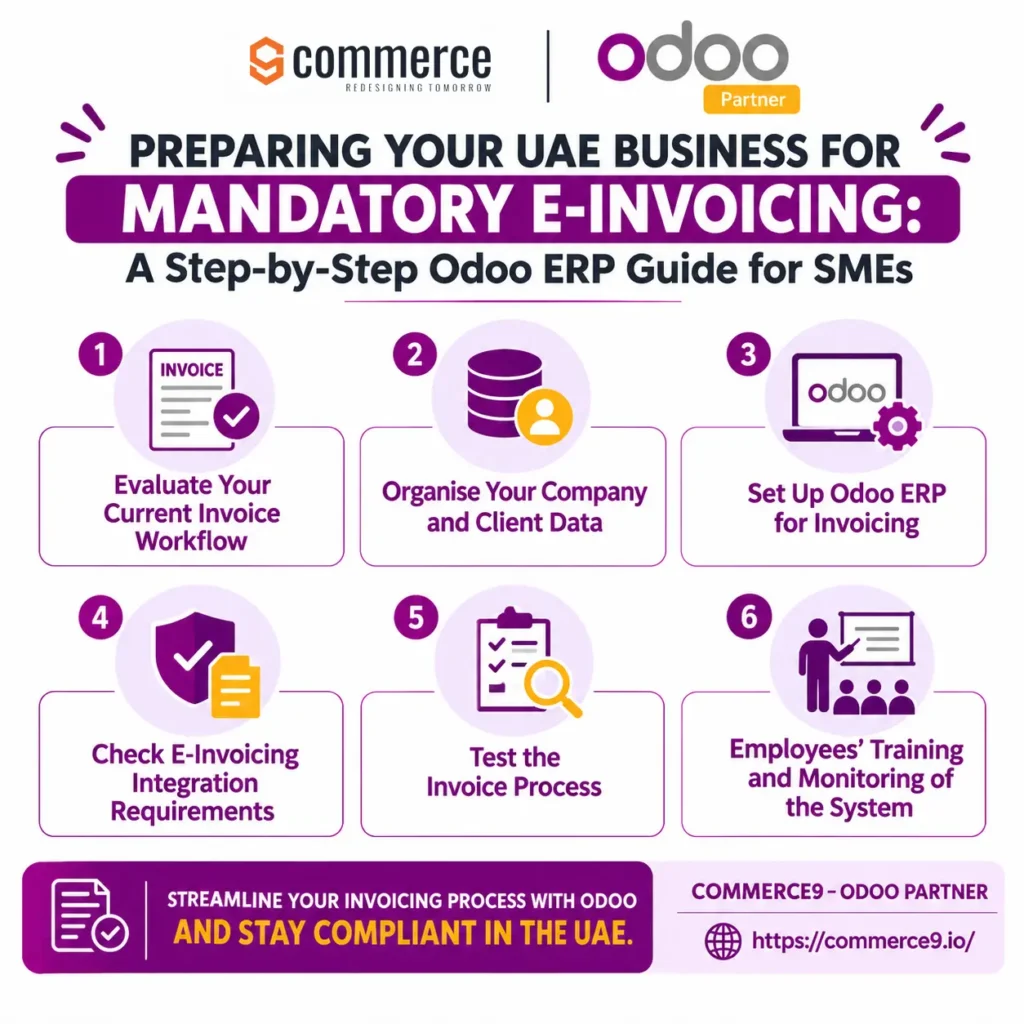
Step-by-Step Guide to Preparing Your Business with Odoo ERP
Evaluate Your Current Invoice Workflow
The first step is to analyze your current processes to find out what jobs are carried out manually, what mistakes were made, and what accounting software you use.
Understand the current method of generating, sending, handling, and saving invoices from both customers and suppliers.
To classify manual operations and issues, confirm if there are any cases of data rewriting or repeating, miscalculation, waiting for approvals, and so on.
When reviewing the management program, determine whether your accounting system meets the requirements for issuing e-invoices in the UAE, and whether it needs improvement or integration with the management program; find out whether your actual accounting system meets the requirements for making e-invoices in the UAE, and if it must be improved or integrated with other solutions.
Organise Your Company and Client Data
At this stage, you need to renew the data for your clients.
You should check clients’ names, addresses of payment, VAT numbers, and contact numbers to generate accurate invoices.
When checking the files of suppliers and products, verify the information, descriptions of goods and services, and prices and taxes.
To ensure the company data is consistent, eliminate outdated information. By making sure the data is accurate
Set Up Odoo ERP for Invoicing
In this step, introduce the Odoo accounting module, configure company information, set up tax settings, and align with UAE requirements.
Introducing the Odoo accounting module simplifies managing customer invoices, vendor bills, payments, and VAT records in one integrated platform.
Configuring company information includes setting up business details, VAT registration information, invoice sequences, and accounting records.
While setting up tax settings, configure applicable VAT rates, tax rules, and accounting treatments based on your business activities.
To align with UAE requirements, ensure the Odoo environment is configured to support relevant UAE tax and e-invoicing requirements, based on your business’s regulatory obligations.
Check E-Invoicing Integration Requirements
Here, understand structured invoice formats, review Odoo compatibility, assess accredited service provider integration, and plan the required integration.
Understanding structured invoice formats helps in following prescribed electronic formats rather than relying on ordinary PDF invoices.
In your Odoo compatibility review, check your Odoo version, available integrations, and technical capabilities to identify their compliance with applicable UAE e-invoicing requirements.
Accredited service provider integration assessment identifies the role of an Accredited Service Provider (ASP) in connecting your ERP system to the UAE e-invoicing framework, where applicable.
To plan the required integration, work with an experienced Odoo implementation partner. This helps in identifying the necessary configurations, integrations, and validation processes. A standard Odoo invoice may not meet the UAE mandatory E-invoicing requirements.
Test the Invoice Process
Here, the focus is on generating sample invoices, verifying VAT calculations, testing integration and validation, and resolving issues before go-live.
Generating sample invoices helps in checking whether customer details, product descriptions, invoice values, and other required information are accurate.
In your VAT calculations verification, review tax rates, VAT amounts, and invoice totals to identify calculation errors.
Integration and validation testing includes checking invoice submission, validation responses, and status through the required e-invoicing integration.
Resolving issues before go-live fixes data inconsistencies, configuration errors, and integration issues before moving the process into the live environment.
Employees’ Training and Monitoring of the System
You need to make sure that your finance staff undergoes necessary training in error management, as well as system control and their updates.
Train your finance staff to handle invoices and keep electronic invoice processing up to date and effective.
Staff trained in error management can detect issues and correct information based on invoices and submissions that are returned for correction.
Monitoring the system’s performance includes tracking invoices and their status, allowing one to catch issues early.
Make sure to carry out the necessary system modifications, taking into consideration all new integrations that may be introduced.
Key Benefits of Using Odoo ERP for E-Invoicing
Centralised Invoicing – Responsible for handling various paperwork related to customer invoices, supplier invoices, payments, and other financial documentation to keep records organized and retrieve invoice information when required.
Manual Work Reduced – Automating invoice generation, payment recording, and accounting entries reduces repetitive data entry and increases time for the finance department to focus on other activities.
Improved VAT Management – Keeping VAT transactions, tax calculations, and financial records organized in Odoo ensures efficient tax reporting.
Enhanced Tracking – Effectively keeping track of invoice statuses, payment deadlines, amounts owed, and overdue payments allows for better management of receivables for SMBs.
Enhanced Business Visibility – Access to centralized financial information, procedural records, and reports helps you make sound decisions regarding proper cash flow management, expenses, and financial planning.
Final Thoughts
This is your first call to be prepared for mandatory e-invoicing, remain compliant, and avoid last-minute implementation problems. Odoo ERP simplifies accounting, manages invoicing, monitors payments, and organizes the accounting and financial records in a single platform.
To prepare in advance, evaluate the existing accounting and invoicing systems and identify gaps to plan required integrations. This will support your UAE mandatory E-invoicing requirements.
Advanced preparation isn’t enough for a smooth transition. You must choose a scalable ERP solution and prepare your employees for the transition. This will help in managing future invoicing requirements more efficiently.
If you’re looking for an experienced and skilled provider, here’s one. Commerce9, an Odoo partner in Dubai, specialises in ERP implementations, digital transformation, and intelligent business solutions to help organisations move beyond traditional ERP deployments toward scalable, AI-enabled systems that drive measurable business outcomes.
Frequently Asked Questions (FAQs)
1. What is mandatory e-invoicing in the UAE?
Mandatory e-invoicing is the UAE’s electronic invoicing system that requires businesses within its scope to issue and exchange structured electronic invoices through the prescribed framework.
2. Is e-invoicing mandatory for SMEs in the UAE?
Applicability depends on the UAE’s implementation rules, business category, and any applicable exemptions. SMEs should review the requirements relevant to their business.
3. Can Odoo ERP support UAE e-invoicing?
Yes. Odoo can manage accounting and invoicing operations, but businesses must implement the appropriate UAE-compliant integration to meet e-invoicing requirements.
4. How can SMEs prepare for mandatory e-invoicing?
SMEs should review existing invoicing processes, update business and customer data, configure accounting software, test required integrations, and train employees.
5. Do PDF invoices qualify as e-invoices in the UAE?
No. An ordinary PDF invoice alone does not meet the structured electronic invoicing requirements. E-invoices must follow the prescribed format and exchange framework.

Vinoj VK
Vinoj brings over 15 years of industry experience, offering deep knowledge and practical expertise. He is dedicated to delivering reliable insights and high-quality content across a wide range of topics.