

Before we get to the how part, here’s a line on what CRM software is. It is a software platform that manages and centralises customer details, communication history, leads, sales opportunities, interactions, customer relationships, and sales processes.
How do they manage? CRM organises customer information, tracks sales activities, manages leads, and schedules follow-ups. These functions help them monitor their pipelines, maintain customer records, and manage opportunities.
What are the benefits of AI in the CRM? AI-powered CRM for sales management analyses customer data, identifies sales patterns, predicts customer behaviour, suggests relevant actions, automates repetitive tasks, and helps teams understand customer needs to deliver promising leads.
What Is an AI-Powered CRM?
An AI-powered customer relationship management system that manages customer data, sales activities, and interactions. It integrates traditional CRM functions, such as contact management, lead tracking, and sales pipeline management, with AI capabilities. This automates and improves the workflow.
CRM’s AI-powered CRM for sales management include predictive analytics, automated data entry, AI-based lead scoring, sales forecasting, and intelligent recommendations. They help managers focus on leads, forecast revenue, monitor team performance, and make informed decisions. The sales team can also save time with automated repetitive tasks and managing customer interactions.
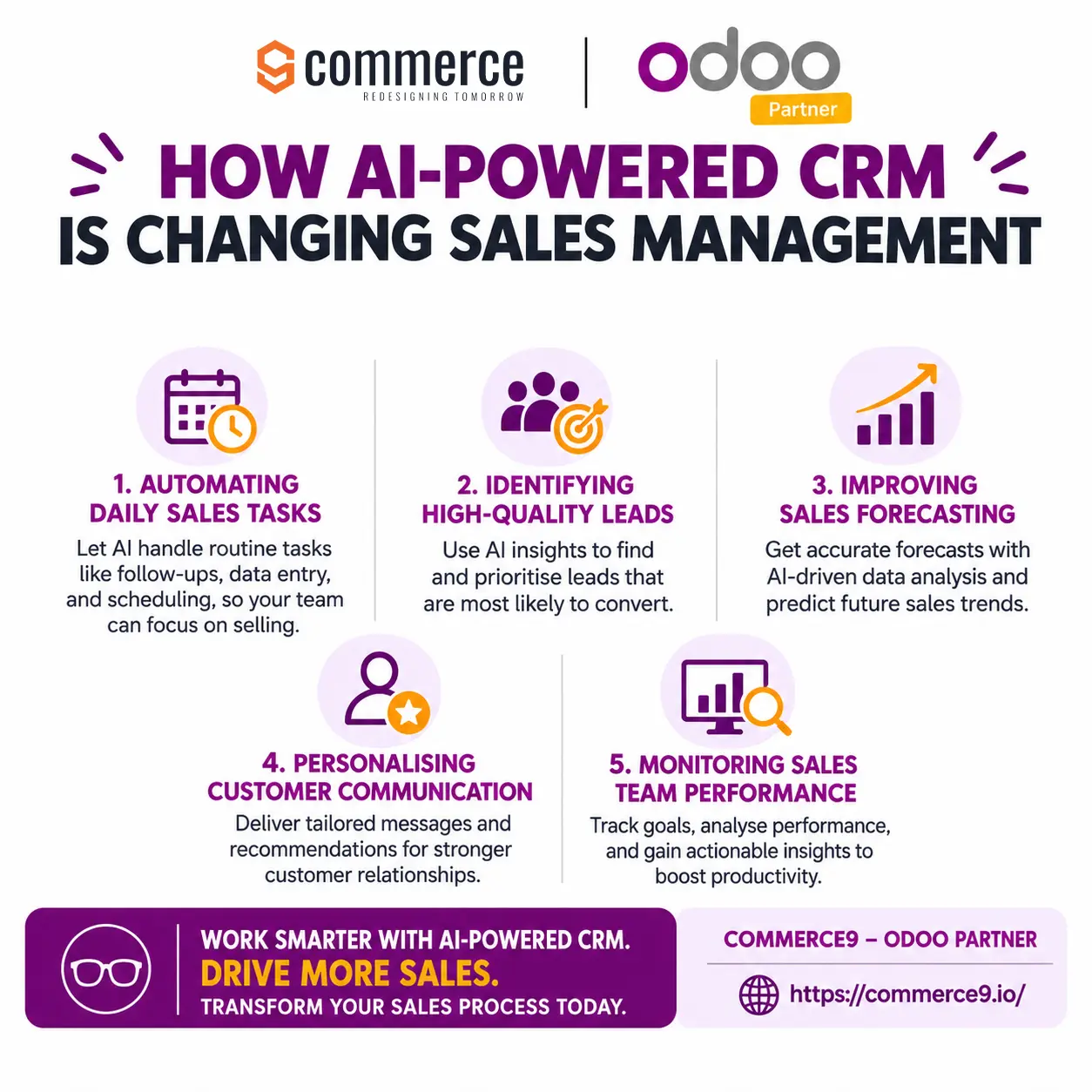
How AI-Powered CRM Is Changing Sales Management
Automating Daily Sales Tasks
- AI automates data entry, generates meeting summaries, drafts emails, schedules follow-up reminders, automates administrative tasks, and improves sales team management.
- Automated data entry reduces manual data entry and errors by capturing and updating customer details, sales activities, and interaction records in the CRM.
- AI-generated meeting summaries summarise sales meetings, highlight important discussion points, and identify follow-up actions. This maintains accuracy in records.
- AI helps sales representatives draft personalised emails based on customer information, previous interactions, and sales context.
- Follow-up reminders are scheduled based on customer interactions, pending tasks, and sales opportunities. This reduces your chance of missing leads.
- Automating repetitive administrative tasks gives sales representatives more time to communicate with leads, answer customer queries, and build relationships.
- For the sales department, AI reduces the time spent on manual tracking and administrative work. This gives them more time to monitor team performance, identify sales opportunities, and improve overall sales strategies.
Identifying High-Quality Leads
- AI-powered CRM for sales management does this by analysing customer behaviour and automating lead scoring. This prioritises sales and improves sales efficiency.
- Customer behaviour analysis includes website activity, previous interactions, purchase history, and available sales data. Analysing these will help the team understand the customers’ interests and buying intent.
- AI automates lead scoring based on engagement levels, customer preferences, interactions, and conversion potential. This helps identify high-quality lead prospects.
- These functions give teams time to focus on high-scoring leads and help identify less promising leads early, reducing wasted effort, managing time effectively, and focusing on highly converting opportunities.
Improving Sales Forecasting
- Forecasting includes analysing historical sales data, evaluating current opportunities, setting realistic sales targets, and planning resources.
- Historical sales data includes previous sales records, buying patterns, and seasonal trends. Analysing them identifies patterns and estimates future sales performance.
- Current opportunities include active sales opportunities, deal values, customer interactions, and pipeline activity. Evaluating them predicts which lead will convert.
- You can use AI-generated predictions to set realistic sales targets. This helps in setting sales targets based on expected demand and pipeline performance.
- Forecasting helps managers plan resources, such as allocating budgets, assigning sales teams, planning inventory, and preparing resources based on expected business demand.
- Knowing AI’s benefits isn’t just enough; you should know its limitations. AI-generated forecasts’ accuracy is not guaranteed; they are estimates. The accuracy can be influenced by the quality, completeness, and reliability of the available data.
Personalising Customer Communication
- Personalisation includes understanding customer preferences, creating relevant communication, and building strong customer relationships.
- To understand customer preferences, AI analyses customer data, including interests, purchase history, preferences, and previous interactions. This gives the sales teams a clear picture of what individual customers need.
- For better customer engagement, consider relevant and timely communication. This makes them feel understood, encourages them to interact with the business, and increases the likelihood of conversions.
- Using AI insights can help you create relevant communication such as personalised emails, relevant products, and follow-up messages based on customers’ interests and buying behaviour.
- To build stronger customer relationships, maintain consistent, personalised interactions. These build customer trust, improve satisfaction, and encourage long-term customer loyalty.
Monitoring Sales Team Performance
- Monitoring includes tracking sales activities, monitoring conversion rates, identifying performance gaps, and providing timely support and coaching.
- AI monitors conversion rates and deal progress by tracking lead conversion rates, sales pipeline movement, and deal progress. This gives managers a clear understanding of individual and overall team performance.
- Performance gaps are identified through delayed deals, missed follow-ups, inactive leads, and opportunities that need top priority. Identifying them saves your sales results.
- AI-driven insights provide timely support and coaching to find where sales representatives need support, and provide targeted coaching.
Key Benefits of AI-Powered CRM for Businesses
- Better Productivity – AI automates repetitive tasks such as data entry, follow-up reminders, and customer interactions, allowing sales teams to focus on important activities.
- Faster Decision-Making – AI analyses sales data and customer behaviour to provide actionable insights, helping managers make informed business decisions quickly.
- Improved Lead Conversion – AI evaluates and prioritises leads based on their potential, helping sales teams focus on prospects who are more likely to convert.
- Better Customer Experience – AI helps businesses understand customer preferences and deliver timely, relevant, and personalised communication across different touchpoints.
- More Accurate Planning – AI analyses historical sales data, identifies trends, and supports sales forecasting, helping managers plan targets and resources more effectively.
- Stronger Team Coordination – A centralised CRM keeps customer information, communication history, and sales updates organised, helping teams collaborate more efficiently.
The actual benefits of an AI-powered CRM depend on implementation quality, data accuracy, system configuration, and how effectively teams use its features.
Conclusion
AI-powered CRM is transforming sales management by automating routine tasks, delivering valuable customer insights, and helping teams make better sales decisions. It helps sales professionals work more efficiently, prioritise opportunities, and personalise interactions while building meaningful customer relationships. However, businesses can achieve greater value from AI-powered CRM by combining intelligent automation with reliable data, well-trained employees, and a customer-focused sales strategy.
Commerce9, an Odoo partner in Dubai, specialises in ERP implementations, digital transformation, and intelligent business solutions to help organisations move beyond traditional ERP deployments toward scalable, AI-enabled systems that drive measurable business outcomes.