

Modern ERP systems are what turn a business into a profitable one. They improve your productivity by managing operations and automating repetitive tasks. Why an ERP system is needed is clear, but which one is the right ERP is what we need to figure out. It is crucial to figure it out because that choice can affect your business’s scalability, costs, and long-term growth.
A familiar competition is Odoo vs Zoho One. Both of these platforms provide integrated apps, but they differ in flexibility, customisation, scalability, and implementation.
This is why you need to read this Odoo vs Zoho One comparison blog. This blog will help you understand what your business needs – Odoo or Zoho.
What is Odoo?
Odoo is an open-source ERP system that manages multiple operations from a single platform. The platform provides comprehensive business modules for CRM, sales, inventory, accounting, HR, manufacturing, purchasing, and more. These modules enable seamless data sharing and increased collaboration all on a single database. Odoo is highly customisable. Based on your industry, workflow, and size, you can customise your platform. Its scalability allows you to start small and grow along the way.
What is Zoho One?
Zoho One is a fully cloud-based SaaS solution, accessible to users from any location. This platform also provides apps that handle sales, marketing, finance, HR, and customer support. They require minimal setup and configuration but can be expanded according to new requirements. This enables flexible app selection and quick implementation.
Odoo vs Zoho One: Key Differences
System Structure
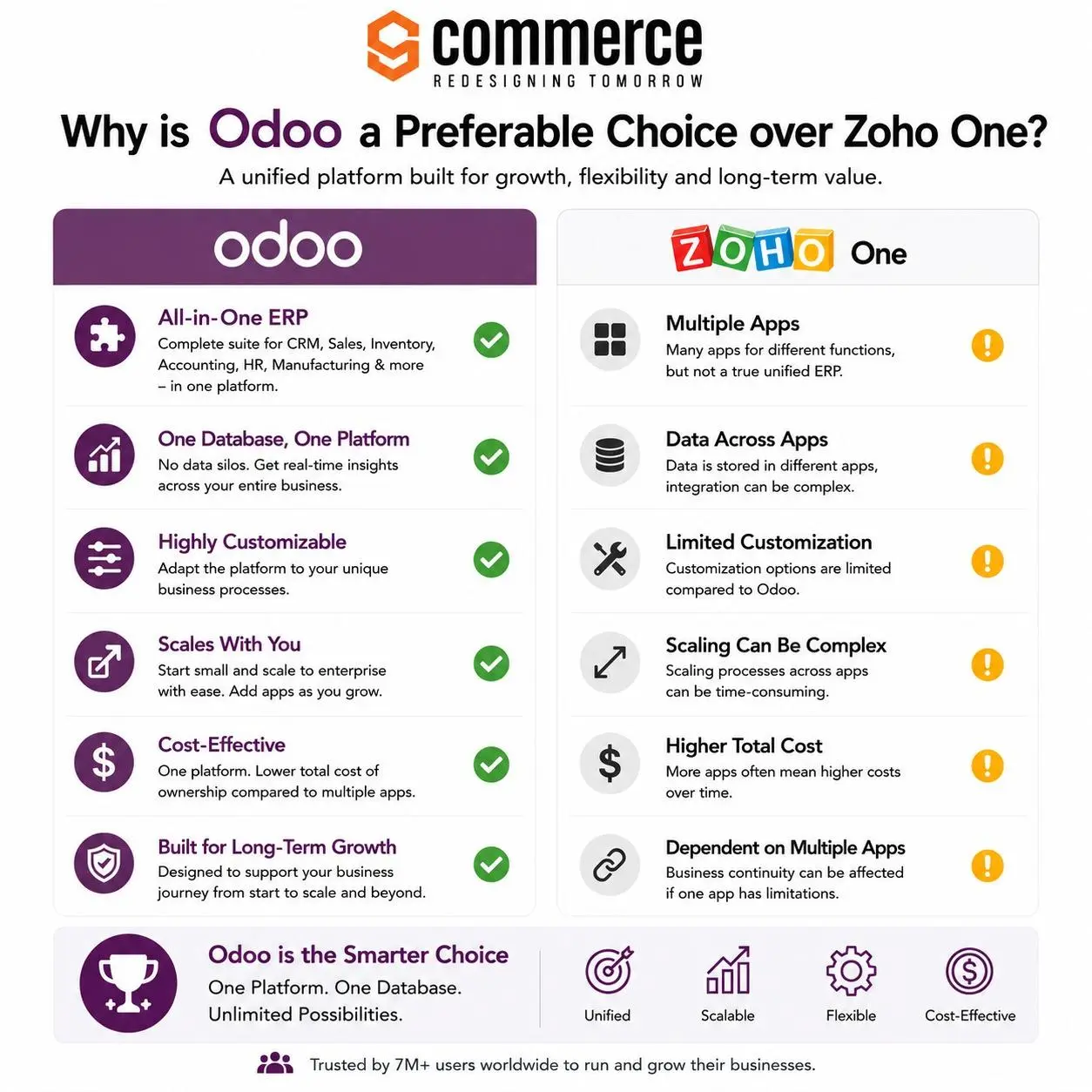
Odoo is an all-in-One ERP system. It is a complete suite for CRM, sales, inventory, accounting, HR, manufacturing, and more. Zoho provides multiple apps. These apps are created for different functions, so it is not a true unified ERP.
Data Management
Odoo is one database, one platform. No data silos. You can get real-time insights across your entire business. Zoho offers data across apps, but they are stored in different apps. So, integration can be complex.
Customization
Odoo is highly customisable. It adapts the platform to your unique business processes. Zoho only has limited customisation compared to Odoo.
Scalability
In Odoo, scalability is up to you. You can start small and scale enterprises with ease. You can add apps as you grow. Scaling in Zoho can be complex. The scaling processes across apps can be time-consuming.
User Experience
Odoo provides a modern, modular, and visually clean interface. But it also has a sheer number of features that can be confusing if not given proper training. Zoho provides an extensive, cost-effective suite for business applications. Although it is affordable and customisable, the user experience is highly mixed, cluttered, and frustrating.
Advantages of Odoo
The advantages of Odoo are:
All-in-one platform – Centralises data to automatically update when an action occurs.
Modular and scalable – You can start small and update based on your requirements and business growth.
Highly customisable – The architecture helps you customise the features according to the workflow and operating procedures.
Cost-effective – You only have to spend lower licensing and setup costs, which saves your budget for implementation.
Intuitive interface – Appears on a modern, user-friendly design. It simplifies onboarding and increases the high team adoption rates.
Real-time reporting – The dashboards display a 360-degree view of your operations. This helps in making faster, data-driven decisions across departments.
Limitations of Zoho One
Zoho One’s limitations are:
Licensing requirements – Zoho needs an ‘all-employee’ pricing model. It means you have to purchase a license for each employee.
External user costs – For roles such as accountants or external contractors, you must purchase a paid user license. Only then can these roles access Zoho Books or Zoho Projects.
Creator portal limits – Even with an enterprise plan, you can only have a low number of free portal users accessing Zoho Creator. For this low number, you have to purchase expensive blocks worth 250.
Unattended access to Zoho Assist – The standard remote support tool limits up to approximately 5 machines. IT service providers or departments with numerous unattended devices should pay extra licensing tiers.
Application usage thresholds – Apps within the bundle have certain software limits. Also, Zoho forms have rigid fields and storage limitations.
API limits and advanced CRM features – Zoho CRM’s bundled version does not have the improved API call limits and heavy storage capabilities in Zoho’s standalone Enterprise or Ultimate tiers.
Cost Comparison
Odoo provides a flexible module-based pricing model. This allows businesses to pay only for what they need. The Zoho One subscription model offers a bundled subscription that gives you access to multiple applications with a single pricing plan.
So, which is cost-effective? That one is up to you. Both can be budget-friendly depending on the number of users, modules, and business requirements. But the ‘lower initial investment’ phase can change because when your business grows, your requirements change, and when your requirements change, you will have to start paying additional payments for customisation and implementations. In that case, Odoo might charge based on your changes, while Zoho One provides predictable subscription charges. Before you select a plan, you should check out the licensing, implementation, support, upgrades, and scalability.
Why Businesses Prefer Odoo
Odoo is widely chosen for four reasons:
Unified system advantage – Odoo is a single platform that offers apps for sales, inventory, accounting, and HR.
Better control over data – Odoo’s centralised data management enhances accuracy, visibility, and decision-making across departments.
Strong scalability – Based on your business expansion, you can keep adding modules and features for a profitable workflow.
Long-term business growth support – Odoo’s flexible architecture helps you enhance your efficiency and adapt to the changing market demands.
Conclusion
The Odoo vs Zoho One is a never-ending one, because both work best according to your business’s goals, budget, scalability requirements, and operational needs. These two platforms provide unique strengths, from flexibility and customisation to ease of use and enterprise capabilities that match your business needs. So, evaluate your workflows, growth plans, and technical requirements before deciding. Based on your future expansion, integrations, and evolving customer expectations, choose a platform.
Commerce9, an Odoo partner in Dubai, is known for providing smart ERP consultation services. Contact us for your consultation.