

To understand the Odoo vs Microsoft Dynamics 365 vs Oracle NetSuite championship, you need to know what an ERP is. Enterprise Resource Planning (ERP) is an all-in-one platform, made to simplify a daily workflow. Here, you get everything, accounting, inventory, sales, purchasing, HR, and reporting.
How does an ERP make it easy? It optimises operations, automates daily tasks, improves data accuracy, and reports real-time insights that improves your decision making. You can leverage most of it when you choose the right ERP system. Cut to the Odoo vs Oracle NetSuite vs Microsoft Dynamics 365 comparison. These three are unique in their own way. They have their own pricing, customisation, scalability, and deployment options.
Want to know which one is cut out for your business? Continue scrolling.
Quick Overview of Each Tool
From this section, you’ll be reading the blog in three parts, one for Odoo, one for Microsoft Dynamics 365 Business Central, and one for Oracle NetSuite.
Odoo is an open-source, modular solution. It offers flexibility, affordability, and customisable applications. If you’re a small or mid-sized business, then this is the right scalable, cost-effective solution.
Microsoft Dynamics 365 Business Central is a comprehensive ERP that integrates with Microsoft tools such as Excel, Outlook, and Teams. This works perfectly for mid-sized businesses.
Oracle NetSuite is a cloud-native, all-in-one platform that manages finance, operations, inventory, CRM, and business analytics. This ERP is made for fast-growing and large enterprises.
Now that you have a quick technical knowledge of what these three are, let’s compare each based on pricing, ease of use and setup, and features and customisation.
Pricing Comparison
Odoo
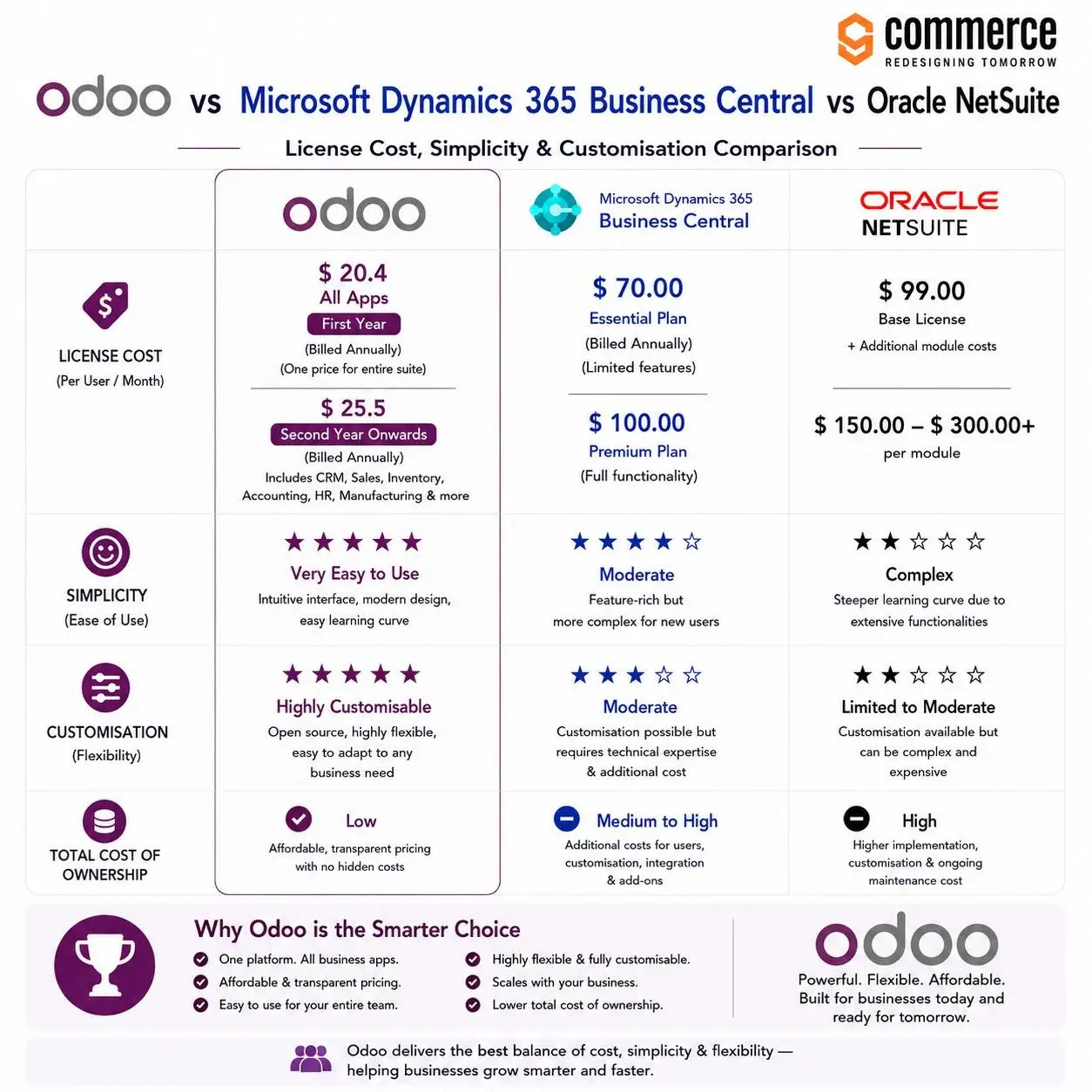
For the first year, it costs $20.4 per month. This one cost covers the entire suit. The bill comes annually. From the second year, it costs $25.5, which will also be billed annually. These two schemes include CRM, sales, inventory, accounting, HR, manufacturing, and more.
Microsoft Dynamics 365 Business Central
Microsoft offers two pricing plans, essential and premium. The essential plan costs $70. It is billed annually and only covers limited features. For a functional package, you must upgrade to the premium plan, which costs up to $100.
Oracle NetSuite
Oracle NetSuite’s basic plan costs up to $99 which covers a base license. If you need to add any modules, you have to pay an additional cost. The premium plan costs up to $150 – $300+ per module.
Features & Customization
Odoo
Odoo is highly customisable, open source, highly flexible, and adapts easily to any business needs. It offers a vast array of native modules, including CRM, e-commerce, manufacturing, and inventory. provides all-in-one features directly out of the box. You can activate what you need without complex third-party tools.
Microsoft Dynamics 365 Business Central
Microsoft Dynamics 365 Business Central offers moderate features. Customisation is possible but requires technical expertise and additional cost. This platform works best for deep financial and operational control. seamlessly integrates with Microsoft Office, Outlook, and Power BI. This easily runs your daily tasks entirely within familiar Microsoft interfaces.
Oracle NetSuite
Oracle NetSuite’s features are limited to moderate, customisation available but can be complex and expensive. It is purpose-built as a unified suite for managing multiple locations and subsidiaries. The features include strong financial management, robust CRM, and built-in global capabilities, such as multi-currency handling.
Best For Which Business Type
Odoo
Odoo works best for Startups, small businesses, and budget-conscious teams wanting complete control. The ‘open-source’ platform is like a Lego set. You only must buy the apps you need today. Tomorrow, for your expansion, you can buy more apps accordingly. Since it is a single, all-in-one system, it means you can start with the necessary basic tools.
Microsoft Dynamics 365 Business Central
If you are a traditional, small-to-medium-sized business using Microsoft 365 from the very beginning, then this is what you need. It can be easily linked to daily tools. Microsoft Dynamics 365 Business Central is like an advanced smartphone with all Microsoft apps pre-installed. Here, you can update an invoice right from Microsoft Outlook or use Power BI to make smart graphs of your sales.
Oracle NetSuite
Oracle NetSuite is made for fast-growing, global, and inventory-heavy businesses (like wholesale or e-commerce). It perfectly handles “multi-entity” management. This means it easily manages multiple currencies, languages, and tax laws across global offices. Oracle NetSuite is like a massive, custom-built mansion. It has every room you will ever need as you grow, but to set it up, you need a large budget and professional builders.
Comparison Table
| POINT OF COMPARISON | ODOO | MICROSOFT DYNAMICS 365 BUSINESS CENTRAL | ORACLE NETSUITE |
| Pricing Comparison | First year – $20.4 per month. Second year – $25.5. Billings are annual. Include CRM, sales, inventory, accounting, HR, manufacturing, and more.
| Essential plan – $70. Billed annually and covers limited features. Premium plan – $100
| Basic plan – $99. Covers a base license. For more modules, the premium plan costs up to $150 – $300+ per module.
|
| Features & Customisation | Highly customisable Open source Highly flexible, Adapts easily to any business needs. Vast array of native modules, including CRM, e-commerce, manufacturing, and inventory. All-in-one features directly out of the box. You can activate what you need without complex third-party tools.
| Moderate features
Customisation is possible but requires technical expertise and additional cost. | Moderate features Customisation is available, but it can be complex and expensive. Purpose-built as a unified suite for managing multiple locations and subsidiaries. Features include strong financial management, robust CRM, and built-in global capabilities, such as multi-currency handling.
|
| Best For Which Business Type | Startups, small businesses, and budget-conscious teams that want complete control. | Traditional, small-to-medium-sized business, using Microsoft 365 from the very beginning. | Fast-growing, global, and inventory-heavy businesses (like wholesale or e-commerce). |
Conclusion
Business niches and their needs are unique, so are the ERP solutions. The three ERP systems differ based on the business size, budget, operational complexity, and long-term goals. In the Odoo vs Microsoft Dynamics 365 vs Oracle NetSuite competition, Odoo stands out as a popular option because it offers flexible, scalable, and cost-effective ERP solutions to adapt across various industries.
Just because Odoo is a popular choice, it doesn’t mean your business’s right choice should be Odoo. You should choose the ERP solution that supports growth, streamlines operations, and evolves with your changing business requirements.
Commerce9, an Odoo partner in Dubai, is known for providing smart ERP consultation services. We help you evaluate, implement, and optimize Odoo solutions to maximize efficiency, productivity, and long-term business success. If you’re feeling your workflow is not thriving with the existing ERP system, let’s connect over a free consultation.